Welcome to Get Star Weld!

Welcome to Get Star Weld!
09 Jun, 2026
Choosing the right welding torch is not purely a technical decision — it directly affects output quality, operating costs, and team efficiency.
One of the most common questions welding professionals face is this: should you be using air-cooled or water-cooled welding torches?
Whether you work in manufacturing, fabrication, or high-volume production, this choice matters. The wrong torch type can lead to overheating, unplanned downtime, inconsistent welds, and avoidable expenses.
This guide breaks down both options in detail so you can make the right call for your operation.
A welding torch is the handheld or robotic tool that delivers heat — and in MIG/TIG welding, shielding gas — to create a weld. It is the operational core of your welding system.
Welding generates intense heat. Without adequate cooling, the torch body, cables, and consumables degrade rapidly. This leads to poor arc quality, accelerated wear, and expensive replacement cycles.
Cooling type is therefore one of the most important factors when selecting a welding torch for industrial use.
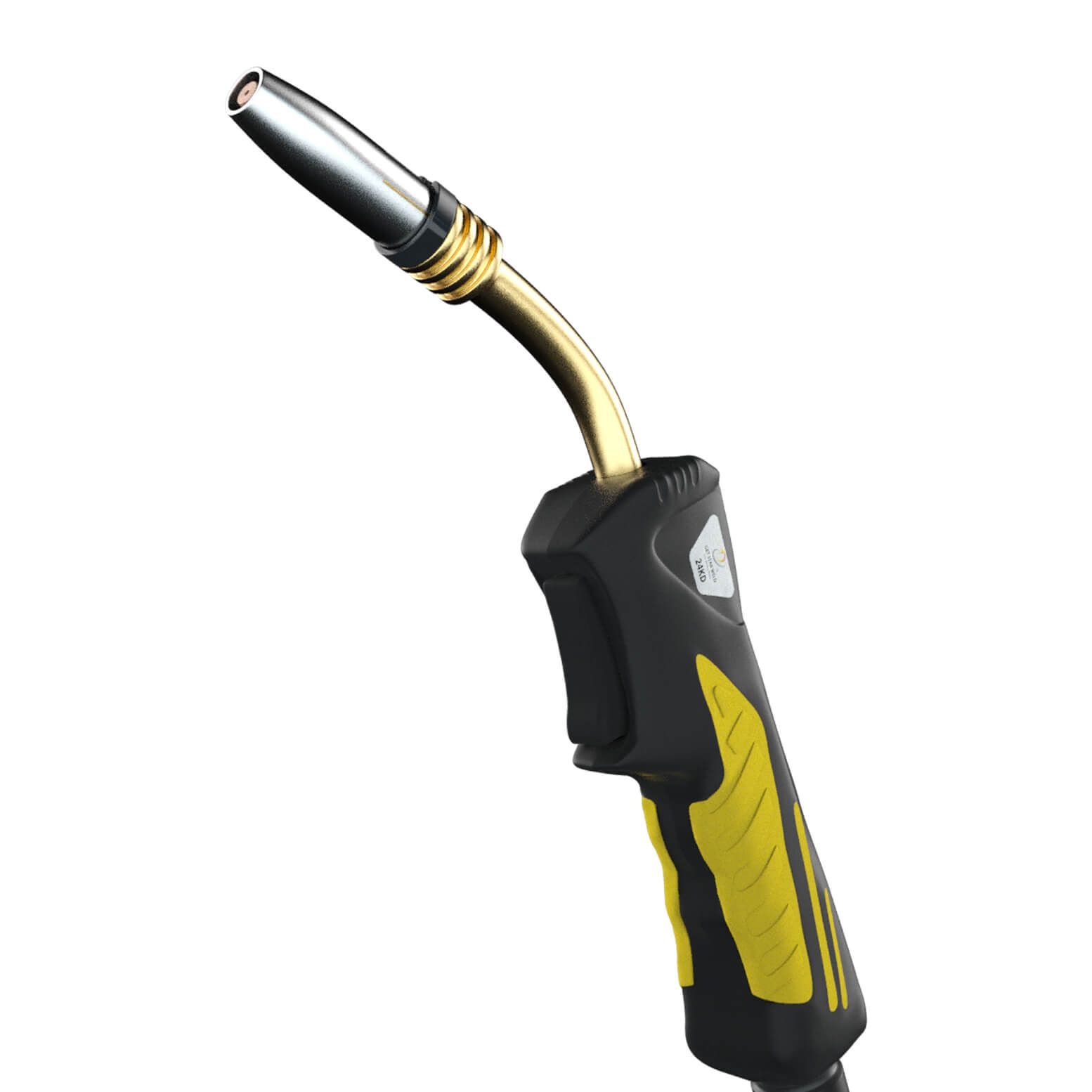
Air-cooled welding torches dissipate heat through ambient airflow and the shielding gas passing through the torch body. No external cooling unit is required, which keeps the setup simple and the footprint small.
Pros
Cons
Water-cooled welding torches use a circulating water system to remove heat from the torch body. A dedicated cooling unit pumps cold water through the torch and returns the heated water to be cooled and recirculated. This allows the torch to operate at significantly higher amperage and duty cycles without overheating.
Pros
Cons
|
Feature |
Air-Cooled |
Water-Cooled |
|
Cooling Method |
Air & shielding gas |
Circulating water system |
|
Duty Cycle |
Up to 60% |
Up to 100% |
|
Amperage Range |
Up to 500A |
Up to 600A+ |
|
Weight |
Lighter |
Heavier |
|
Upfront Cost |
Lower |
Higher |
|
Maintenance |
Simple |
More involved |
|
Best For |
Light to medium welding |
Heavy industrial welding |
|
Setup Complexity |
Minimal |
Requires cooling unit |
Use these four questions to guide your decision:
If your welders are running arcs for more than 60% of every 10-minute period, water-cooled torches are the more reliable choice. For lighter or intermittent work, air-cooled torches are entirely adequate.
Consistent welding above 400A calls for water-cooling. Below that range, air-cooled torches handle the thermal load well in most applications.
Water-cooled systems require a cooling unit, which adds cost and takes up floor space. Where budget or workspace is constrained, air-cooled torches offer a dependable and cost-effective solution.
For field welding, maintenance jobs, or work in tight spaces, air-cooled torches offer the mobility and flexibility that water-cooled setups cannot match.
Air-cooled and water-cooled welding torches each serve a distinct purpose. Air-cooled torches are cost-effective, portable, and well-suited to low- to medium-duty applications. Water-cooled torches are built for high-heat, high-volume environments where consistent performance and equipment longevity are essential.
The right choice depends on your workload, amperage requirements, production targets, and budget. Selecting the correct torch type improves weld quality, reduces downtime, and extends the life of your equipment.
Looking for reliable welding torches for your business? Get Star Weld supplies high-performance air-cooled and water-cooled solutions built for industrial applications. Talk to our team today.
Air-cooled torches rely on ambient air and shielding gas to manage heat, making them suitable for light to medium welding tasks. Water-cooled torches use a circulating water system to handle higher amperages and continuous operation in heavy industrial settings.
In heavy-duty applications, water-cooled torches typically outlast air-cooled ones because they manage heat more efficiently. Air-cooled torches subjected to sustained high-output use wear out faster and require more frequent consumable replacement.
Yes. Air-cooled TIG torches work well for low- to medium-amperage welding and shorter sessions. For continuous or high-amperage TIG welding, a water-cooled torch is the better option.
For heavy-duty and high-production environments, yes. Water-cooled torches reduce downtime, extend consumable life, and improve weld consistency. The higher upfront cost is typically recovered through lower long-term operating expenses.
In many cases, yes — provided the torch connector is compatible with your welding machine. However, switching to a water-cooled system also requires adding a cooling unit. Always verify compatibility with your equipment supplier before making a change.
Lorem ipsum dolor sit amet, consectetur adipiscing elit. Suspendisse viverra mauris eget tortor.